
Apr . 01, 2024 17:55 Back to list
Pressure Gauge how to calculate pressure gauge Performance Analysis
Introduction
Pressure gauge calculation is a critical aspect of process instrumentation, encompassing the determination of appropriate gauge ranges, materials, and accuracy for specific applications. It's a discipline extending beyond simply reading a dial; it's rooted in fluid dynamics, material science, and precise engineering. Within the broader industrial chain, pressure gauges act as vital data points for control systems, safety interlocks, and process optimization. A miscalculated gauge, or one improperly specified, can lead to inaccurate readings, process instability, equipment damage, and potentially hazardous conditions. Core performance parameters revolve around accuracy, repeatability, hysteresis, and the ability to withstand process conditions like temperature, pressure surges, and corrosive media. This guide will detail the methods for calculating pressure gauge requirements, considering these core parameters and industry best practices.
Material Science & Manufacturing
The construction of pressure gauges relies heavily on specific material properties. Bourdon tubes, commonly used in mechanical gauges, are typically manufactured from alloys like beryllium copper, phosphor bronze, or stainless steel (316L being a frequent choice for corrosive environments). The material’s elastic modulus (Young's Modulus) is paramount; it determines the tube’s flexibility and sensitivity to pressure changes. Higher modulus materials require thicker walls for the same pressure range, impacting gauge size and cost. Diaphragm gauges, often used for low-pressure measurements, utilize materials like stainless steel, Hastelloy, or even specialized polymers like PTFE depending on chemical compatibility. Manufacturing processes vary. Bourdon tubes are created through a complex forming and annealing process, requiring precise control of temperature and bending radii to prevent stress concentrations. Welded connections are critical and subject to non-destructive testing (NDT) like radiography or ultrasonic testing to ensure integrity. Diaphragm gauges involve deep drawing or etching techniques, requiring meticulous control of material thickness and surface finish. The gauge case material – often steel or aluminum – is selected for robustness and environmental protection, with consideration for ingress protection (IP) ratings. Manufacturing parameter control includes stringent quality control of raw material composition, dimensional accuracy of components, and leak testing to meet industry standards like ASME B40.100.
Performance & Engineering
Calculating the correct pressure range for a gauge necessitates understanding the process's operating parameters. Firstly, determine the Normal Operating Pressure (NOP). Secondly, identify the Maximum Operating Pressure (MOP) – the highest pressure the system will realistically experience, including surges and transient events. The gauge range should be selected such that the NOP falls approximately within 25-75% of the full-scale range. This provides optimal resolution and accuracy. Force analysis is key in diaphragm gauge design. The force exerted on the diaphragm is proportional to the pressure difference; the diaphragm’s deflection is then translated into a measurable signal. Environmental resistance is critical. Temperature fluctuations impact the zero point and span of the gauge, requiring temperature compensation techniques. Vibration can cause premature wear and inaccurate readings, necessitating the use of liquid filling (glycerin or silicone oil) or vibration-dampening materials. Compliance requirements, such as those dictated by PED (Pressure Equipment Directive) in Europe or ASME Section VIII in the US, dictate design calculations, material traceability, and quality control procedures. Functional implementation relies on the gauge’s output signal. Mechanical gauges provide a visual indication, while electronic gauges offer outputs like 4-20mA, HART, or Fieldbus for integration with control systems.
Technical Specifications
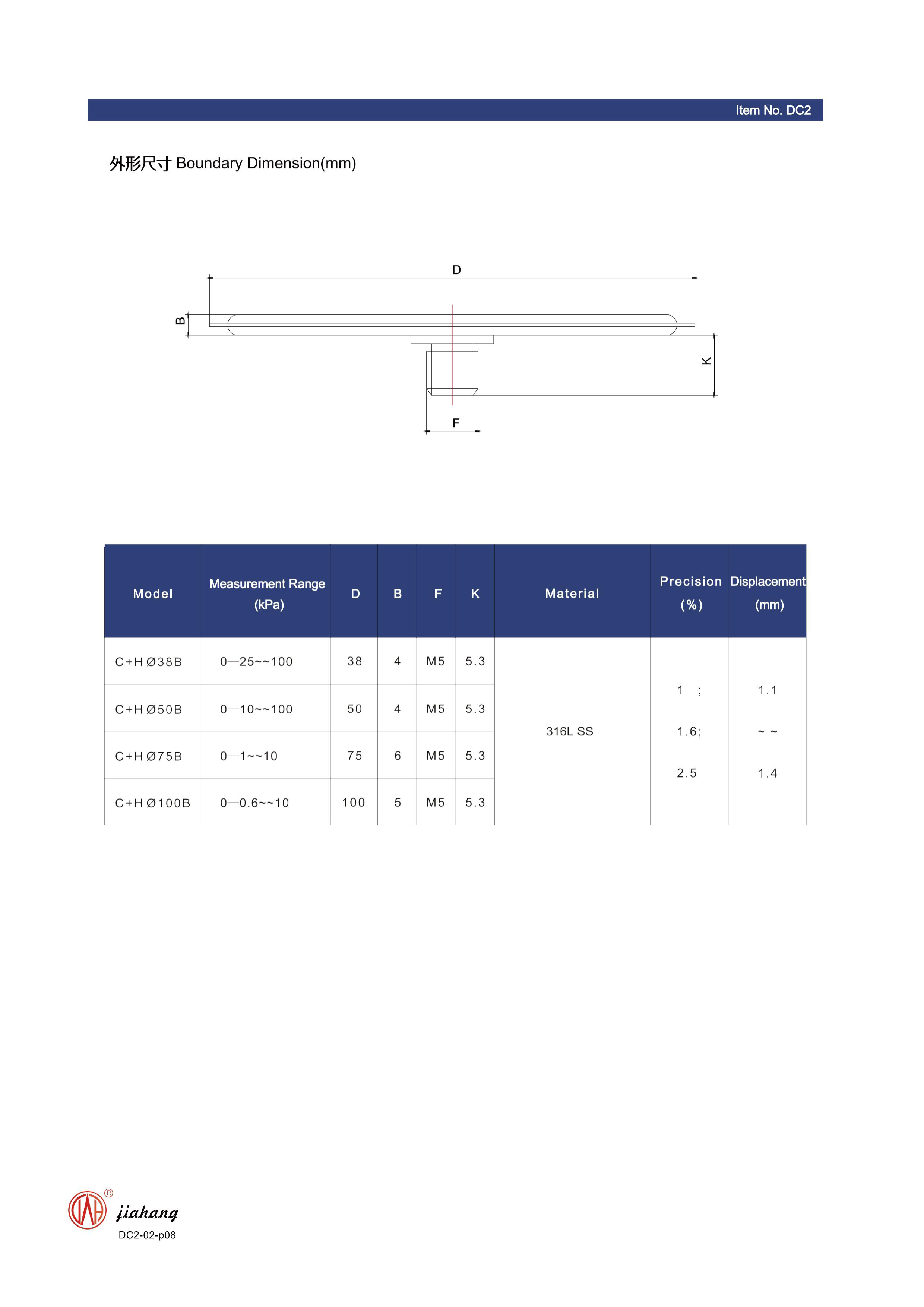
| Parameter | Unit | Typical Range | Accuracy (Full Scale) |
|---|---|---|---|
| Pressure Range | psi/bar/kPa | 0-30 to 0-10,000 psi | ±1.0% to ±3.0% |
| Connection Size | in/mm | 1/8", 1/4", 1/2" NPT, G1/2" | N/A |
| Case Material | - | Steel, Stainless Steel, Aluminum | N/A |
| Wetted Parts Material | - | Stainless Steel 316L, Beryllium Copper, Hastelloy | N/A |
| Operating Temperature | °F/°C | -40 to 250 °F (-40 to 121 °C) | N/A |
| Ingress Protection | IP Rating | IP65, IP67, IP68 | N/A |
Failure Mode & Maintenance
Pressure gauge failure modes are diverse. Fatigue cracking in Bourdon tubes occurs due to repeated pressure cycles, particularly near welded joints. Corrosion, especially in corrosive media, can lead to tube rupture or blockage. Diaphragm gauges are susceptible to rupture from overpressure events or fatigue failure due to prolonged flexing. Zero drift is a common issue, caused by temperature changes or mechanical stress. Hysteresis, a difference between readings on increasing and decreasing pressure, indicates material degradation. Blockage of the connection port due to particulate matter can cause erroneous readings. Maintenance involves regular visual inspection for physical damage, leaks, and corrosion. Periodical calibration against a traceable standard is crucial to ensure accuracy. Liquid-filled gauges require inspection for liquid level and discoloration, indicating contamination. Preventive maintenance includes implementing filters upstream of the gauge to remove particulate matter and ensuring the gauge is adequately protected from vibration and extreme temperatures. Replacement should be considered if the gauge exhibits significant drift, hysteresis, or structural damage. A thorough failure analysis, including metallurgical examination, should be conducted for catastrophic failures to identify root causes and prevent recurrence.
Industry FAQ
Q: What is the impact of pulsation on pressure gauge accuracy and lifespan?
A: Pulsation significantly impacts both. Rapid pressure fluctuations introduce fatigue stresses, accelerating wear and potentially leading to premature failure, especially in mechanical gauges. Pulsation also introduces inaccuracies in the reading, as the gauge needle struggles to track the fluctuating pressure. Solutions include using a pulsation dampener (snubber) upstream of the gauge, selecting a gauge with a liquid-filled case for vibration damping, and choosing a gauge with a higher cycle life rating.
Q: How do I select the appropriate wetted material for a specific process fluid?
A: Material selection is critical. Consult a chemical compatibility chart that details the resistance of various materials to the process fluid. Consider factors like concentration, temperature, and flow velocity. Stainless steel 316L is often a good starting point, but for highly corrosive fluids (e.g., strong acids), Hastelloy or PTFE-lined diaphragms may be necessary. Incorrect material selection leads to corrosion, erosion, and ultimately, gauge failure.
Q: What are the benefits of using a digital pressure gauge over a mechanical gauge?
A: Digital gauges offer several advantages. They provide higher accuracy, remote monitoring capabilities, and digital output signals for integration with control systems. They often include features like data logging, alarm settings, and temperature compensation. However, they require a power supply and may be more expensive than mechanical gauges.
Q: How often should pressure gauges be calibrated?
A: Calibration frequency depends on the application's criticality and the gauge's accuracy requirements. A general guideline is to calibrate annually, or more frequently (e.g., quarterly) for critical applications or gauges exposed to harsh conditions. Calibration should be performed by an accredited calibration laboratory using traceable standards.
Q: What is the significance of the gauge's accuracy rating (e.g., ±1.0% FS)?
A: The accuracy rating indicates the maximum permissible deviation from the true pressure value. “±1.0% FS” means the reading can be off by up to 1.0% of the full-scale range. For example, on a 0-100 psi gauge, the reading could be anywhere between 99 psi and 101 psi. Choosing a gauge with an appropriate accuracy rating is crucial for ensuring process control and safety.
Conclusion
Calculating pressure gauge requirements is a multifaceted process demanding a thorough understanding of process dynamics, material science, and relevant industry standards. Correct gauge selection involves determining appropriate pressure ranges based on operating and maximum pressures, selecting compatible wetted materials to resist corrosion, and considering environmental factors like temperature and vibration. Regular calibration and preventive maintenance are vital for ensuring long-term accuracy and reliability.
Looking forward, the trend toward smart pressure gauges with wireless communication and predictive maintenance capabilities will continue. Implementing these technologies will enhance process monitoring, reduce downtime, and optimize operational efficiency. Adherence to international standards and a commitment to best practices are paramount for ensuring safe and reliable pressure measurement in all industrial applications.
 English
  Arabic
  China
China  China (Taiwan)
  Danish
  Dutch
Dutch  French
  German
  Greek
Greek  Hindi
Hindi  Indonesian
  Italian
  Japanese
  Korean
  Latin
Latin  Polish
  Portuguese
  Russian
  Spanish
  Turkish