
Apr . 01, 2024 17:55 Back to list
Water Pressure Gauge how to read water pressure gauge Performance Analysis
Introduction
Water pressure gauges are essential instruments for monitoring and controlling fluid pressure in a wide range of industrial and domestic applications. These gauges provide a visual indication of pressure, allowing operators to ensure systems are functioning within safe and efficient parameters. Accurate pressure readings are critical for preventing equipment damage, ensuring process control, and maintaining system safety. This guide will provide a comprehensive overview of water pressure gauge operation, encompassing the underlying material science, manufacturing processes, performance characteristics, common failure modes, and relevant industry standards. Understanding these aspects is paramount for effective implementation, maintenance, and troubleshooting of these vital components. The core pain point in the industry surrounds misinterpretation of gauge readings leading to preventative maintenance oversight, ultimately resulting in system failures and production downtime. This document aims to mitigate these risks by providing an in-depth understanding of gauge functionality.
Material Science & Manufacturing
The construction of a typical water pressure gauge relies on a combination of materials selected for their mechanical strength, corrosion resistance, and elastic properties. The Bourdon tube, the primary sensing element, is commonly manufactured from copper alloys (e.g., beryllium copper, phosphor bronze) or stainless steel (304, 316). Copper alloys are favored for their high elasticity and fatigue resistance, facilitating accurate pressure measurement over repeated cycles. Stainless steel offers superior corrosion resistance, especially in aggressive environments. The gauge case is typically constructed from steel, aluminum, or reinforced plastics. The dial face is often made of polycarbonate or acrylic, chosen for clarity and durability. Manufacturing processes include deep drawing for the Bourdon tube, precision welding for joining components, and automated assembly. Critical parameters during Bourdon tube manufacturing involve controlled annealing to achieve optimal elasticity and precise dimensional control to ensure linearity and accuracy. Surface treatments, such as passivation for stainless steel, are employed to enhance corrosion resistance. Quality control involves rigorous leak testing and calibration against certified pressure standards. Material selection is also heavily influenced by the fluid compatibility; incompatible materials can lead to corrosion, erosion, and ultimately, gauge failure. Specifically, the effects of chlorides and sulfides on copper alloys or pitting corrosion on stainless steels needs careful consideration.
Performance & Engineering
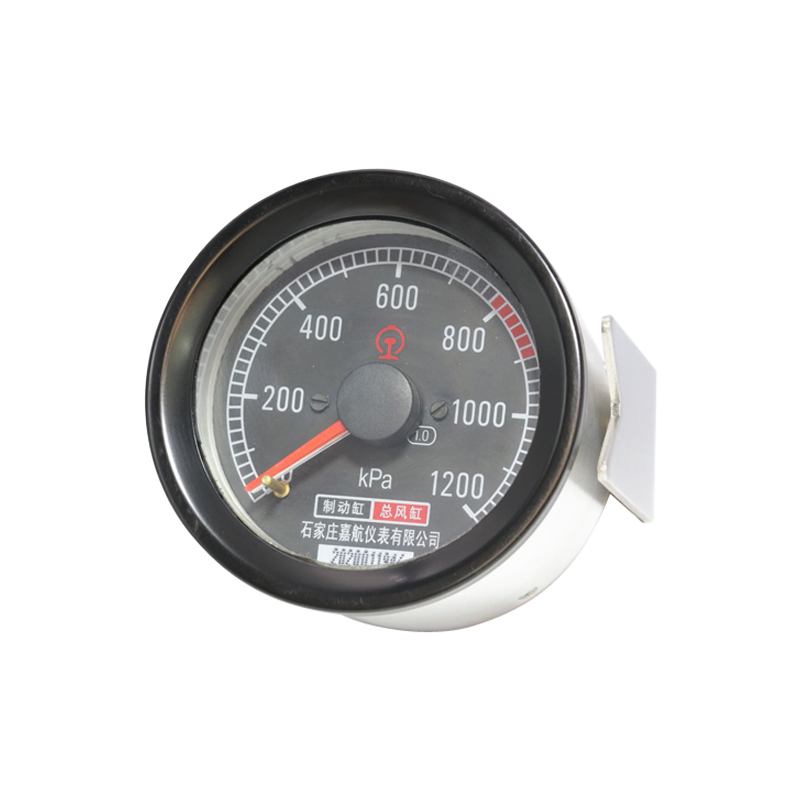
The performance of a water pressure gauge is fundamentally governed by the principles of elastic deformation and force transmission. When pressure is applied to the internal lumen of the Bourdon tube, it attempts to straighten, causing a proportional displacement of the connected mechanical linkage. This linkage then drives the movement of a pointer across a calibrated dial. Engineering analysis centers around force balance, stress analysis, and hysteresis effects. The Bourdon tube's wall thickness, diameter, and shape directly influence its sensitivity and pressure range. Environmental resistance is a key performance consideration. Temperature fluctuations can cause expansion and contraction of the Bourdon tube, leading to inaccuracies. Vibration and shock can also affect the gauge's readings and long-term reliability. Compliance requirements vary depending on the application. For potable water systems, gauges must meet NSF/ANSI 61 standards for lead content and material safety. In hazardous locations, gauges must be intrinsically safe or explosion-proof, adhering to ATEX or IECEx standards. Proper installation, including minimizing pipeline vibration and protecting the gauge from direct sunlight and extreme temperatures, is crucial for optimal performance. A key concern is creep, the tendency for the Bourdon tube to deform permanently under sustained pressure, leading to drift in the readings.
Technical Specifications
| Parameter | Units | Typical Range | Accuracy |
|---|---|---|---|
| Pressure Range | PSI | 0-30 to 0-10,000 | ±1.6% of full scale |
| Connection Size | NPT | 1/8", 1/4", 1/2" | Varies by model |
| Case Material | - | Steel, Aluminum, Plastic | - |
| Bourdon Tube Material | - | Copper Alloy, Stainless Steel | - |
| Operating Temperature | °F | -40 to 200 | - |
| Dial Size | inches | 1.5", 2", 2.5", 4" | - |
Failure Mode & Maintenance
Common failure modes in water pressure gauges include Bourdon tube rupture, linkage failure, case leaks, and dial pointer sticking. Bourdon tube rupture typically occurs due to overpressure, material fatigue, or corrosion. Linkage failure can result from wear, corrosion, or excessive vibration. Case leaks can occur due to gasket failure or cracks in the case material. Dial pointer sticking is often caused by lubrication breakdown or internal corrosion. Preventative maintenance is critical for extending the gauge's lifespan and ensuring accurate readings. Regular visual inspections should be conducted to check for leaks, corrosion, and damage to the case or dial. The gauge should be periodically calibrated against a certified pressure standard to verify its accuracy. Lubrication of the linkage mechanism may be required. If the gauge is exposed to corrosive fluids, regular cleaning and protective coating application are recommended. In case of noticeable drift or erratic readings, the gauge should be removed from service and inspected for internal damage. Avoid exposing the gauge to extreme temperatures, shock, or vibration. For gauges used in critical applications, consider implementing a scheduled replacement program based on operating conditions and manufacturer recommendations. Fatigue cracking, often initiated at stress concentration points, is a particularly insidious failure mode that is difficult to detect visually.
Industry FAQ
Q: What is the significance of the gauge's accuracy rating (e.g., ±1.6% of full scale)?
A: The accuracy rating indicates the maximum permissible error in the pressure reading. For example, a gauge with an accuracy of ±1.6% of full scale on a 0-100 PSI range could theoretically display a reading between 98.4 PSI and 101.6 PSI when the actual pressure is 100 PSI. It's crucial to select a gauge with an accuracy appropriate for the application; higher accuracy gauges are needed for precise process control.
Q: How do I determine the appropriate pressure range for my application?
A: Select a gauge with a pressure range that encompasses the typical operating pressure, as well as any anticipated pressure surges or fluctuations. Avoid selecting a gauge with a range that is excessively higher than the expected operating pressure, as this can reduce accuracy. It is best practice to select a range where the typical operating pressure falls within 25-75% of the full-scale range.
Q: What are the implications of using a gauge in a vibrating environment?
A: Vibration can cause premature wear of the linkage mechanism, leading to inaccurate readings and potential failure. Consider using a gauge with a liquid-filled case to dampen vibration. Additionally, proper mounting and isolation techniques can help reduce the impact of vibration. Regularly inspect the gauge for signs of wear or damage.
Q: What is the purpose of a glycerin-filled gauge?
A: Glycerin-filled gauges are used in applications where vibration is present or where a pulsating pressure signal is being measured. The glycerin dampens the movement of the internal components, providing a more stable and accurate reading and extending the lifespan of the gauge. Glycerin also provides lubrication and protects internal components from corrosion.
Q: How often should a water pressure gauge be calibrated?
A: Calibration frequency depends on the application and operating conditions. For critical applications, annual calibration is recommended. In less demanding applications, calibration every 2-3 years may suffice. Any time a gauge is suspected of being inaccurate, it should be calibrated immediately.
Conclusion
Water pressure gauges are fundamental to numerous industrial processes and safety systems. A thorough understanding of their construction, operating principles, and potential failure modes is essential for effective utilization and maintenance. Proper material selection, coupled with precise manufacturing techniques, ensures gauge accuracy and longevity. Regular inspection, calibration, and preventative maintenance are vital for maintaining optimal performance and preventing costly downtime.
The increasing demand for remote monitoring and data logging is driving advancements in pressure gauge technology, with the integration of digital sensors and wireless communication capabilities. Future developments are likely to focus on enhancing accuracy, reliability, and ease of integration into complex control systems, coupled with improved diagnostics and predictive maintenance features. Selecting the correct gauge for the operating environment and fluid media will ensure optimal operational performance and safety.
 English
  Arabic
  China
China  China (Taiwan)
  Danish
  Dutch
Dutch  French
  German
  Greek
Greek  Hindi
Hindi  Indonesian
  Italian
  Japanese
  Korean
  Latin
Latin  Polish
  Portuguese
  Russian
  Spanish
  Turkish