
Apr . 01, 2024 17:55 Back to list
vacuum pressure gauge Performance Analysis
Introduction
Vacuum pressure gauges are precision instruments employed to measure the absolute pressure within a vacuum environment, typically ranging from atmospheric pressure down to extremely low pressures approaching absolute zero. They are critical components across a broad spectrum of industries including semiconductor manufacturing, vacuum coating, scientific research, aerospace, and leak detection. Unlike gauge pressure measurements which reference ambient pressure, vacuum gauges measure pressure relative to a perfect vacuum. Their technical position within the industrial chain is as a vital sensing element within a larger control and monitoring system, providing data necessary for process optimization and quality control. Core performance characteristics include accuracy, range, response time, and long-term stability, all of which are dictated by the underlying sensing technology and construction materials. The selection of an appropriate vacuum gauge is heavily influenced by the specific application requirements, including the vacuum level, process gases involved, and required measurement resolution.
Material Science & Manufacturing
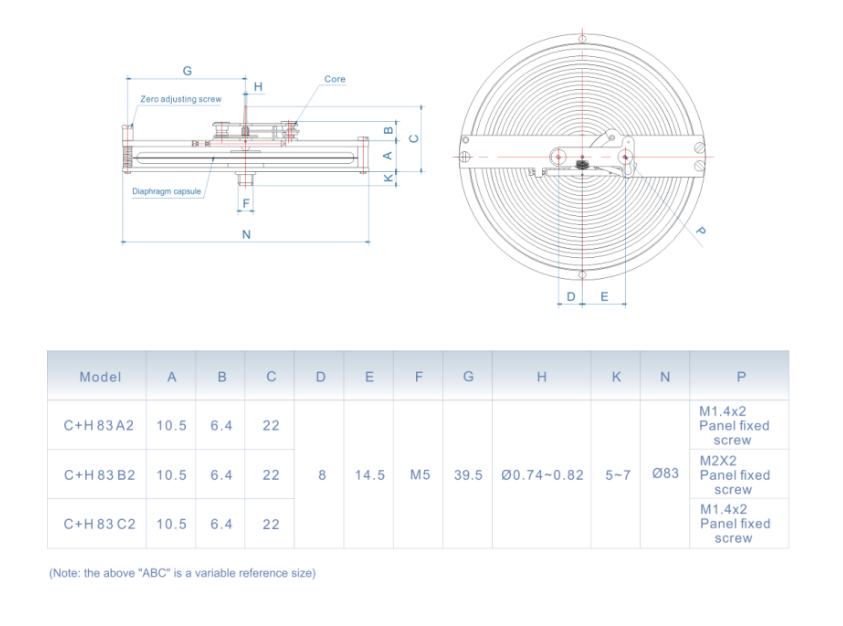
The construction of vacuum pressure gauges involves a diverse range of materials selected for their compatibility with vacuum environments, mechanical strength, and corrosion resistance. Bourdon tubes, diaphragms, and housings are commonly fabricated from stainless steel (304, 316L), Hastelloy, or specialized alloys depending on the corrosive potential of the measured gases. Sensing elements, such as thermistors or piezoelectric crystals utilized in Pirani and capacitance manometers respectively, require materials with predictable thermal and electrical properties. Glass and ceramic components are often employed for insulators and feedthroughs due to their low outgassing rates. Manufacturing processes vary depending on the gauge type. Bourdon tubes are formed through cold drawing and annealing processes, ensuring consistent wall thickness and elasticity. Diaphragms are typically manufactured via deep drawing or diffusion bonding, achieving high precision and flatness. Capacitance manometers rely on precise machining and assembly of diaphragms and electrodes to maintain a stable capacitance gap. Vacuum gauges employing active sensing elements (e.g., Pirani, thermocouple) necessitate precise calibration procedures involving traceable pressure standards to ensure accuracy. Key parameter control during manufacturing includes material purity (minimizing outgassing), dimensional tolerances (maintaining sensor sensitivity), and weld integrity (preventing leaks). Helium leak testing is a standard quality control procedure to verify the vacuum tightness of the gauge assembly.
Performance & Engineering
The performance of a vacuum pressure gauge is governed by a complex interplay of physical principles and engineering design considerations. Force analysis focuses on the stresses imposed on sensing elements by the pressure differential. Bourdon tubes experience tensile and compressive stresses that are proportional to the applied pressure, while diaphragms undergo deflection. Understanding these stress distributions is crucial for determining the gauge's measurement range and linearity. Environmental resistance is a critical factor, particularly in industrial applications where gauges may be exposed to temperature fluctuations, vibration, and corrosive atmospheres. Materials selection and protective coatings (e.g., passivation) are employed to mitigate these effects. Compliance requirements, such as those outlined by SEMI standards for semiconductor manufacturing, dictate stringent performance specifications for vacuum gauges used in critical processes. Functional implementation involves signal conditioning circuitry to amplify and convert the sensor signal into a usable output (e.g., 4-20mA, 0-5V). Temperature compensation is often necessary to account for the thermal drift of the sensor and circuitry. Calibration procedures, utilizing primary pressure standards like McLeod gauges or capacitance manometers, are essential for ensuring traceability and accuracy. The selection of a gauge type (e.g., Pirani, thermocouple, capacitance manometer, ionization gauge) depends on the specific vacuum range and accuracy requirements of the application. For example, Pirani gauges are suitable for rough vacuum measurements, while ionization gauges are used for ultra-high vacuum applications.
Technical Specifications
| Parameter | Pirani Gauge | Capacitance Manometer | Ionization Gauge |
|---|---|---|---|
| Pressure Range | 1 x 10⁻³ to 1000 mbar | 1 x 10⁻⁴ to 1000 mbar | 1 x 10⁻⁸ to 1 x 10-12 mbar |
| Accuracy | ±1% of full scale | ±0.1% of full scale | ±5% of reading |
| Response Time | <1 second | <100 milliseconds | <1 second |
| Operating Temperature | -20°C to 80°C | -20°C to 80°C | -20°C to 80°C |
| Mounting Flange | KF, ISO | KF, ISO | KF, ISO |
| Output Signal | 4-20mA, 0-5V | 4-20mA, 0-5V | 4-20mA, 0-5V |
Failure Mode & Maintenance
Vacuum pressure gauges are susceptible to a variety of failure modes, stemming from both mechanical and electronic causes. Fatigue cracking can occur in Bourdon tubes or diaphragms due to repeated stress cycles, particularly in applications with frequent pressure fluctuations. Delamination of diaphragm materials can arise from contamination or improper bonding during manufacturing. Degradation of sensor elements, such as thermistors in Pirani gauges, can occur due to exposure to corrosive gases or prolonged high-temperature operation. Oxidation of metallic components can lead to increased resistance and inaccurate readings. Contamination from process gases or pump oil can deposit on sensor surfaces, altering their sensitivity and response time. Electrical failures can result from damaged wiring, corroded connectors, or malfunctioning signal conditioning circuitry. Routine maintenance includes periodic cleaning of sensor surfaces to remove contaminants, leak testing of the gauge assembly to identify leaks, and recalibration against a traceable pressure standard. Preventive maintenance schedules should be implemented based on the application and operating conditions. For Pirani gauges, filament contamination significantly reduces lifespan, necessitating periodic filament replacement. Capacitance manometers require careful handling to prevent damage to the delicate diaphragm. Ionization gauges require regular cleaning of the ionizing filament and collector electrode to maintain sensitivity.
Industry FAQ
Q: What is the primary difference between a Pirani gauge and a capacitance manometer, and which is more suitable for a process requiring high accuracy in the 10-3 mbar range?
A: Pirani gauges operate by measuring the thermal conductivity of the gas, while capacitance manometers directly measure pressure by detecting the deflection of a diaphragm. Capacitance manometers are significantly more accurate, generally offering accuracies of ±0.1% of full scale, compared to ±1% for Pirani gauges. For applications requiring high accuracy in the 10-3 mbar range, a capacitance manometer is the preferred choice due to its superior precision and linearity.
Q: How does the choice of materials affect the long-term stability and accuracy of a vacuum pressure gauge when measuring corrosive gases?
A: The choice of materials is paramount when measuring corrosive gases. Stainless steel, while common, may be susceptible to corrosion from certain chemicals. Hastelloy, a nickel-based alloy, offers superior corrosion resistance in many aggressive environments. Furthermore, the sensor diaphragm material should be carefully selected for chemical compatibility. Utilizing appropriate materials minimizes outgassing and prevents chemical attack, ensuring long-term stability and accuracy.
Q: What are the common causes of drift in vacuum pressure gauge readings, and what steps can be taken to mitigate this drift?
A: Drift can be caused by several factors, including temperature fluctuations, contamination of the sensor, and aging of electronic components. Temperature compensation circuitry can minimize drift due to temperature variations. Regular cleaning of the sensor and maintaining a clean vacuum system can prevent contamination. Periodic recalibration against a traceable pressure standard is essential to correct for any residual drift.
Q: What is the significance of the "outgassing rate" of materials used in vacuum pressure gauge construction, and how does it impact overall system performance?
A: The outgassing rate refers to the release of gases adsorbed within the materials of the gauge. High outgassing rates can increase the partial pressure within the vacuum system, reducing the accuracy of the measurement and potentially contaminating the process. Materials with low outgassing rates, such as stainless steel with passivation treatment and certain ceramics, are crucial for maintaining a clean and accurate vacuum environment.
Q: What are the limitations of ionization gauges, and when would you recommend using an alternative technology such as a capacitance manometer?
A: Ionization gauges, while capable of measuring extremely low pressures, are susceptible to inaccuracies due to surface effects and require frequent calibration. They can also be sensitive to contamination and may exhibit non-linearity at higher pressures. Capacitance manometers are preferred when high accuracy, stability, and linearity are required, particularly in the medium to high vacuum range (1 x 10⁻⁴ to 1000 mbar), and when dealing with corrosive gases or processes where frequent recalibration is impractical.
Conclusion
Vacuum pressure gauges are indispensable instruments for monitoring and controlling vacuum processes across a diverse range of industries. Their selection and application require a thorough understanding of the underlying sensing principles, material science considerations, and potential failure modes. The choice between different gauge technologies – Pirani, capacitance manometer, or ionization gauge – is dictated by the specific application requirements, including the pressure range, accuracy demands, and process gas compatibility.
Proper maintenance, including regular cleaning, leak testing, and recalibration, is crucial for ensuring long-term reliability and accuracy. Adherence to relevant industry standards and best practices in material selection and manufacturing processes will further enhance the performance and longevity of these critical components. The ongoing development of more sensitive and robust vacuum gauge technologies will continue to drive innovation in vacuum-based processes and applications.
 English
  Arabic
  China
China  China (Taiwan)
  Danish
  Dutch
Dutch  French
  German
  Greek
Greek  Hindi
Hindi  Indonesian
  Italian
  Japanese
  Korean
  Latin
Latin  Polish
  Portuguese
  Russian
  Spanish
  Turkish