
Apr . 01, 2024 17:55 Back to list
Water Pressure Test Gauge Performance Analysis
Introduction
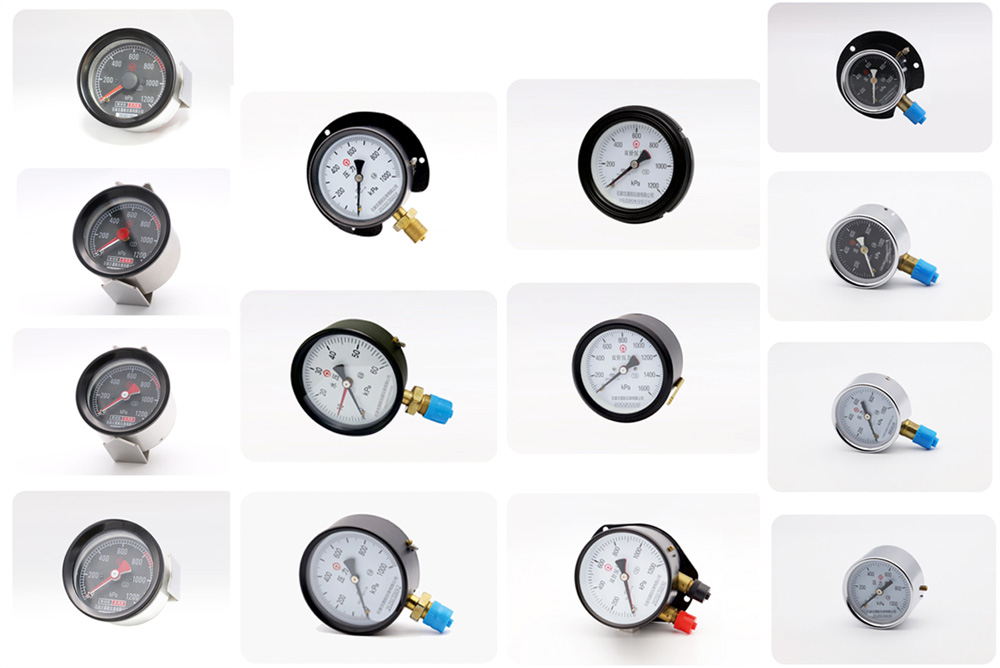
Water pressure test gauges are precision instruments used to measure hydrostatic pressure within closed systems, typically involving liquids. Their primary application lies in ensuring the integrity and leak-proof nature of pipelines, pressure vessels, plumbing systems, and hydraulic components. Positioned within the industrial chain, these gauges function as critical quality control devices, downstream from manufacturing and fabrication processes. Core performance characteristics revolve around accuracy, repeatability, durability under pressure cycling, and resistance to corrosion from the tested medium. The industry faces challenges regarding calibration traceability, the selection of appropriate materials for diverse fluids, and minimizing measurement uncertainty to comply with stringent safety regulations. Increasingly, digital gauges with data logging capabilities are gaining prominence due to the demand for detailed pressure history records for maintenance and forensic analysis.
Material Science & Manufacturing
The construction of a water pressure test gauge necessitates a carefully selected suite of materials. Bourdon tubes, the primary sensing element, are commonly manufactured from alloy steels such as beryllium copper (for enhanced elasticity and corrosion resistance) or carbon steel (for cost-effectiveness in less demanding applications). The case and connections often utilize stainless steel (304 or 316) to provide robust corrosion protection, especially when testing with aggressive fluids. Dial faces are typically made from aluminum or polycarbonate, ensuring readability and resistance to environmental factors. Manufacturing begins with the formation of the Bourdon tube through processes like seamless tube extrusion and subsequent heat treatment to achieve the desired spring characteristics. The tube undergoes rigorous dimensional checks and non-destructive testing (NDT), such as eddy current testing, to identify defects. Assembly involves precise welding or brazing techniques to connect the Bourdon tube to the movement mechanism. Parameter control is crucial: heat treatment temperatures must be tightly regulated to maintain material properties, and welding procedures must adhere to established standards (e.g., ASME Section IX) to ensure joint integrity. Calibration is performed using a deadweight tester, which provides a traceable pressure standard, and adjustments are made to the movement mechanism to ensure accuracy across the gauge’s range. The choice of O-ring material (e.g., Viton, EPDM) for sealing components is dependent on the fluid being tested; chemical compatibility is paramount.
Performance & Engineering
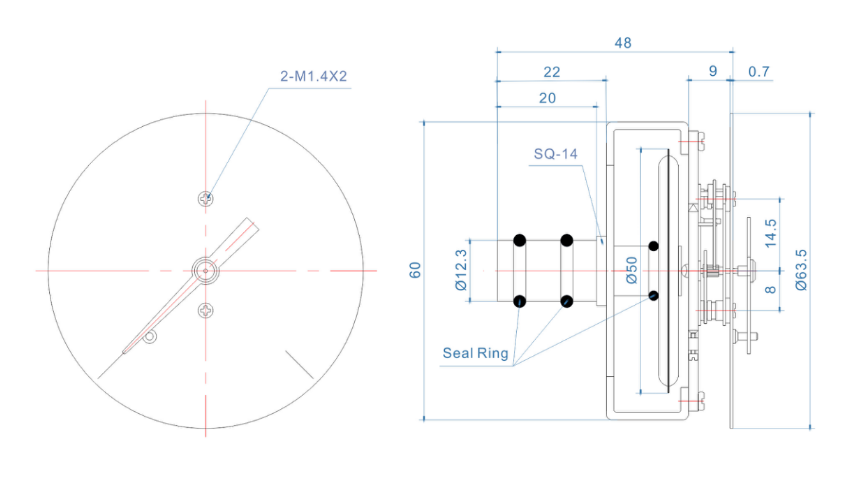
The performance of a water pressure test gauge is dictated by several engineering principles. Force analysis centers on the relationship between applied pressure, the cross-sectional area of the Bourdon tube, and the resulting stress. The Bourdon tube’s curvature and wall thickness are designed to provide a linear relationship between pressure and displacement, which is then translated into a readable scale. Environmental resistance is a key concern. Temperature fluctuations can affect the elasticity of the Bourdon tube and the viscosity of the calibration fluid within the gauge. Gauges intended for outdoor use or harsh environments require robust weatherproofing and potentially temperature compensation mechanisms. Compliance requirements are substantial, with standards like ASME B40.100 dictating accuracy classes and testing procedures. Functional implementation necessitates careful consideration of pressure range selection. Choosing a gauge with a range too wide reduces resolution and accuracy, while a range too narrow risks overpressure damage. Furthermore, the gauge’s response time—how quickly it registers a pressure change—is crucial in dynamic testing scenarios. Damping fluids are often used within the mechanism to mitigate the effects of pressure pulsations and vibrations, enhancing readability and extending gauge life. Static pressure testing vs. cyclical pressure testing also defines material requirements and expected lifespan.
Technical Specifications
| Parameter | Unit | Typical Value | Tolerance |
|---|---|---|---|
| Pressure Range | psi | 0-100 | ±0.25% FS |
| Accuracy Class | - | 1.0 | ASME B40.100 |
| Case Material | - | 304 Stainless Steel | - |
| Bourdon Tube Material | - | Beryllium Copper | - |
| Connection Size | NPT | 1/4" | - |
| Operating Temperature | °F | -20 to 140 | - |
Failure Mode & Maintenance
Water pressure test gauges are susceptible to several failure modes. Fatigue cracking of the Bourdon tube, induced by repeated pressure cycling, is a common issue, particularly at weld points. Corrosion, especially pitting corrosion, can occur if the gauge is exposed to corrosive fluids or environments. Delamination of the dial face coating can reduce readability. Drift in calibration—a gradual change in accuracy—can arise from wear in the movement mechanism or changes in the material properties of the Bourdon tube. Oxidation of internal components can also lead to malfunction. Preventive maintenance is critical. Regular visual inspection for signs of corrosion, leaks, or damage is essential. Calibration should be performed at least annually, or more frequently in high-usage applications, using a certified deadweight tester. Lubrication of the movement mechanism, with a compatible lubricant, can reduce wear and friction. If the gauge is used with aggressive fluids, consider periodic flushing with a compatible solvent to remove any accumulated residue. If a gauge exhibits significant drift or damage, it should be removed from service and either repaired by a qualified technician or replaced. Proper storage in a dry, clean environment when not in use will prolong its lifespan.
Industry FAQ
Q: What is the significance of the accuracy class specified in ASME B40.100?
A: The accuracy class (e.g., 1.0, 1.6) defines the maximum permissible error as a percentage of the gauge’s full scale (FS). A lower number indicates higher accuracy. Selecting the appropriate accuracy class depends on the criticality of the application. For safety-critical systems, a Class 1.0 gauge is typically required to ensure reliable pressure measurements.
Q: How do I determine the correct pressure range for my application?
A: The pressure range should be selected to encompass the expected operating pressures, with a margin of safety. Avoid selecting a range that is too wide, as this reduces resolution and accuracy. Consider the maximum possible pressure that the system could experience, including surge pressures, and ensure the gauge’s range exceeds this value.
Q: What materials are suitable for use with highly corrosive fluids?
A: For highly corrosive fluids, gauges with wetted parts constructed from highly alloyed materials like Hastelloy, Monel, or tantalum are recommended. The Bourdon tube, connections, and any internal components that come into contact with the fluid must be made from these corrosion-resistant materials. Consider also the compatibility of the O-ring material.
Q: What is the best way to calibrate a water pressure test gauge?
A: The most accurate method is to calibrate the gauge against a certified deadweight tester. This provides a traceable pressure standard. The gauge should be calibrated across its entire range, and a calibration certificate should be retained for quality control purposes. It’s crucial to use a qualified calibration laboratory.
Q: What are the common causes of gauge failure in hydraulic systems?
A: Common causes include pressure spikes exceeding the gauge’s range, contamination of the hydraulic fluid leading to internal corrosion or blockage, and mechanical shock or vibration damaging the Bourdon tube or movement. Regular fluid maintenance, shock absorbers, and appropriate gauge selection can mitigate these failures.
Conclusion
Water pressure test gauges are indispensable tools for ensuring the safety and reliability of pressurized systems. Their performance hinges on the careful selection of materials, precise manufacturing processes, and adherence to stringent industry standards. Understanding the potential failure modes and implementing a robust maintenance program are critical for maximizing gauge lifespan and preventing costly downtime.
The evolution of these gauges, particularly with the integration of digital technology for data logging and remote monitoring, reflects the growing demands for advanced pressure management solutions. Continued research into more durable materials and improved calibration techniques will further enhance the accuracy and reliability of these vital instruments, contributing to greater safety and efficiency across diverse industrial applications.
 English
  Arabic
  China
China  China (Taiwan)
  Danish
  Dutch
Dutch  French
  German
  Greek
Greek  Hindi
Hindi  Indonesian
  Italian
  Japanese
  Korean
  Latin
Latin  Polish
  Portuguese
  Russian
  Spanish
  Turkish